Thursday, June 26, 2025

Sunday, June 22, 2025
Language and Power
Language and Power

As a middle school nurse, I often think about all our students, and that definitely includes our emergent bilingual students. Sometimes, it's easy to just see the language difference, but these resources really open up how much more there is to it. They help me understand that these kids are navigating a lot more than just English classes; they're simultaneously adjusting to a new culture, new social dynamics, and often a very different educational system. It's about their whole world, their developing identity as they blend cultures, and how deeply they feel supported here at school. It's a big reminder that just like with any student, especially those facing unique challenges, we need to look at them as a whole person with complex needs and strengths, not just someone learning a new language.
The "Teaching Multilingual Children" resource really highlights how important it is for us, even in the health office, to understand and acknowledge the benefits of students' home languages. It's not simply about them acquiring English; it's about valuing where they come from, their family heritage, and the cognitive advantages that often come with bilingualism. It reminds me that providing a welcoming and safe space, where they feel comfortable communicating their needs without fear of judgment or misunderstanding, is absolutely key. This could mean simple, practical things like having readily accessible translation apps on our devices, utilizing visual aids, or just being extra patient and using clear gestures. The document talks about how their first language can actually serve as a strong foundation, or a "bridge," to help them learn English more effectively, and recognizing that positive connection is a good thing for all of us educators and staff to remember and act upon.
Then there's the "Aria" piece by Rodriguez. That one really challenged me to think because it talks about the personal, deeply emotional side of learning a new language, and the profound feeling of potentially losing a piece of yourself, your family language, and even your connection to your cultural roots. It made me think about how a student who seems quiet, reserved, or perhaps even a little withdrawn, might not just be shy. Instead, they could be struggling intensely to express themselves in a new language, or even feeling a bit of sadness or a sense of loss during this linguistic and cultural shift. As a nurse, seeing a student who appears distressed or withdrawn might now make me think differently, prompting me to consider this added, often invisible, layer of emotional and identity-based adjustment that emergent bilingual students are often navigating. Understanding this helps me approach their well-being with more empathy and sensitivity.
Finally, the YouTube video (https://www.youtube.com/watch?v=LCx55q6e0uA) powerfully reinforces the human element in this educational journey. It shows vividly how much it truly means to these students when we, as school staff, make a genuine effort to connect with them on a personal level and acknowledge their rich, diverse backgrounds. It's not just about what they can't do yet in English, or focusing on perceived deficiencies, but shifting our perspective to appreciate what they can do, and the incredible richness and diversity they bring to our school community. For me, in the health office, this translates into being exceptionally patient, listening carefully to their concerns, and making sure they feel genuinely heard and understood. Whether it's about a simple scraped knee, a headache, or just how they're feeling emotionally that day, making that connection helps build trust and ensures they receive the best possible care.
My daughter teaches third grade MLLs and shared a great resource with me. It is called Colorin Colorado. She used it in her TESOL classes at URI. I included the link if anyone wants to check it out. https://www.colorincolorado.org/
Monday, June 16, 2025
TEACH OUT Summaries
1. Ethnic Studies by Sleeter
Today, we're looking at the The Academic and Social Value of Ethnic Studies: A Research Review" by Christine E. Sleeter. This paper reviews research showing that traditional curricula often present a Euro-American viewpoint, marginalizing other perspectives. This can lead to disengagement among students of color. Ethnic studies addresses this by explicitly acknowledging different viewpoints, examining colonialism and racism, and exploring the experiences and cultural contributions of various communities. The study shows that incorporating ethnic studies can make school more relevant and engaging for students of color. It helps them develop a critical understanding of history and their place within it. It validates their experiences and knowledge, which can boost their academic performance and overall sense of belonging. All students benefit by gaining a broader, more accurate understanding of U.S. history and society.
2. Teaching for Social Justice
So, this article is all about making classrooms a place where everyone feels like they belong and can thrive. It points out that schools sometimes miss the mark by not addressing inequalities based on race, class, and gender. But it's not about what teachers can't do; it's about what they can do. The authors suggest that classrooms should be places where students get a taste of a more just society, where they learn to think critically and develop the skills to make that society a reality. Basically, teaching should connect with students' lives, help them question the world around them, include diverse perspectives, get them actively involved, and create a supportive and joyful environment. And yeah, academics are still important, but the idea is to make learning meaningful and engaging so students actually want to learn.
RI Laws and Policies and Trevor Project Resources
Three Talking Points
1. The gender definitions/examples in the Trevor Project article were really helpfull. I think I will keep this article as a reference. It may be "new" to us, but we can always learn. When we know better, we do better.
Argument Statement
Wednesday, June 11, 2025
Rethinking Troublemakers
Rethinking Troublemakers by Carla Shalaby
Three Talking Points:
Saturday, June 7, 2025
Teach Out Proposal Draft
The Teach Out Project Proposal
I chose the Sleeter article because I kept thinking about Carlos's story. It was so different from my own educational experience. It was something that I really did not thinking about before. I want to share it with my daughter and husband as they both work with under-represented groups so I think it would have the most direct, quickest impact. I will create a pamphlet so it can be easily shared with their colleagues.
Rethinking Schools
Rethinking Schools:
Teaching the Fight for Queer Liberation
By Nick Palazzolo
As a middle school nurse, the article "Teaching the Fight for Queer Liberation" really hits home. I see kids every day who are grappling with their identities, some quietly, some more openly. The article emphasizes that "all students, queer students in particular, deserve to encounter this history so that they might develop a fuller sense of self, examine how questions of gender and sexuality have shaped their present, and imagine where our society might go next." This isn't just about history class; it's about validating their existence. When students feel affirmed and understood, they're healthier, both mentally and physically. I’ve noticed that kids who feel a sense of belonging in school are less likely to come to my office with anxiety or stress-related physical symptoms like stomachaches. I never had a problem because I was always represented in curriculum content. However, this is not always true for LGBTQ and other minority kids.
This focus on teaching queer history and fostering inclusivity directly relates to the principles of Diversity, Equity, and Inclusion (DEI). DEI is all about creating environments where every student, regardless of their background or identity, feels safe, respected, and able to learn. When I have a student who is questioning their gender or sexuality, knowing that our school, in theory, supports DEI means I can confidently point them to resources or staff members who can provide affirming support. It's about recognizing the diverse needs of our student population and actively working to meet them.
However, the recent executive orders, such as last weeks "Ending Radical And Wasteful Government DEI Programs And Preferencing" reading, create a really challenging environment. The order states it is "the policy of the United States to protect the civil rights of all Americans and to promote individual initiative, excellence, and hard work." While that sounds good, the reality is that by "terminat[ing] all discriminatory programs, including illegal DEI and 'diversity, equity, inclusion, and accessibility' (DEIA) mandates," it chills the very efforts that create truly inclusive spaces. I worry that if DEI initiatives are seen as "radical and wasteful," my own school will shy away from discussions about queer history or even providing basic support for LGBTQ+ students, fearing backlash or loss of funding.
The article "Teaching the Fight for Queer Liberation" specifically highlights the countermovement we're seeing, noting that "today we are experiencing a countermovement in response to recent progress on gay rights." In my opinion this is precisely what these executive orders feel like – a deliberate attempt to roll back progress. As a nurse, my concern isn't political ideology; it's the day to day impact on my students. If we're not allowed to openly acknowledge and celebrate the diverse identities within our school, including queer identities, then we're sending a message to those students that their experiences don't matter or, worse, are not welcome. This can lead to increased mental health struggles, social isolation, and a feeling of being unsafe in a building that they are required to spend 6 hours a day in.
Ultimately, for me as a middle school nurse, fostering an inclusive environment isn't about being "radical"; it's about being compassionate and effective in my role. Understanding and supporting all of our students, including our queer students, truly is essential for their overall health and well-being. When we suppress conversations about queer history or dismantle DEI programs, we’re not just impacting curriculum; we’re directly impacting the physical and emotional safety of vulnerable young people. We need to remember that "All students...deserve to develop a fuller sense of self," and that means affirming who they are, not erasing it.
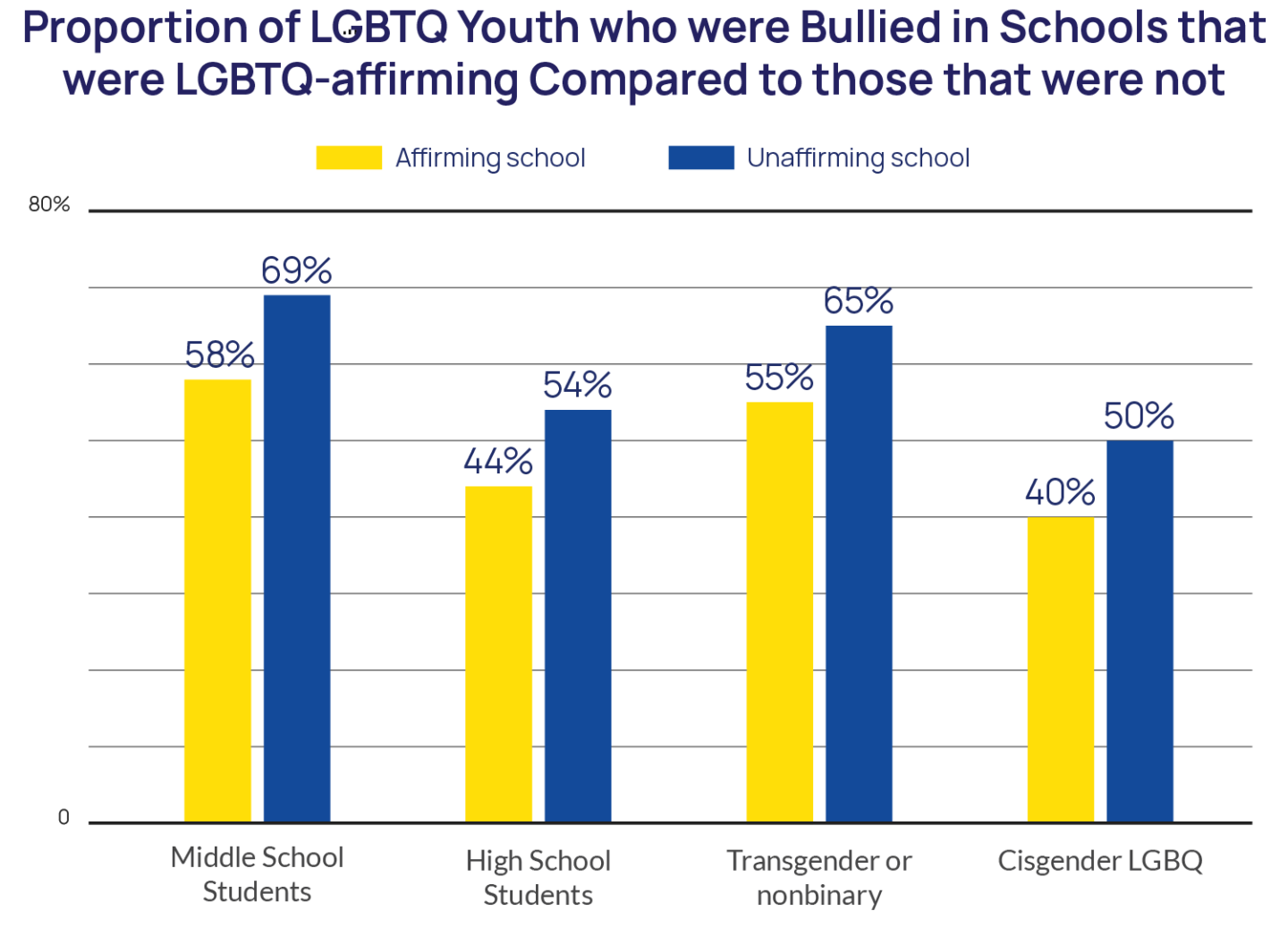
I included this graph from the Trevor Project. It compares the proportion of queer youth who experienced bullying in schools that are LGBTQ affirming with schools that are unaffirming. I think the numbers speak for themselves but I am interested to see what my classmates have to say...
-
Color Blindness is the New Racism by Margalynne Armstrong and Stephanie Wildman https://blacklivesmatter.uk/onewebmedia/77B3ECF9-050D-41B6...
-
Rethinking Schools: Teaching the Fight for Queer Liberation By Nick Palazzolo link to my Rethinking Schools article As a middle school nurse...
-
The Silenced Dialogue: Power and Pedagogy in Educating Other People’s Children by Lisa Delpit Talking Points From the beginning of the tex...


