Wednesday, May 28, 2025

The Silenced Dialogue: Power and Pedagogy in Educating Other People’s Children

 The Silenced Dialogue: Power and Pedagogy in Educating Other People’s Children by Lisa Delpit
Talking Points

  1. From the beginning of the text, Delpit delves into the idea of "skills" versus "process" approaches in education. Delpit quotes, "Children from non-dominant cultures may not have acquired the 'rules of the game' implicitly through their home environments, and therefore need explicit instruction." From my perspective as a school nurse, I've noticed that even with basic health instructions. If I don't explicitly break down medical terms or instructions, some students, especially those whose families may not have much medical exposure, might not fully grasp the information. I am sure that my classmates have seen this more and more with "COVID kids". I am struggling to understand how I can help as a school nurse, especially working at the middle school level.
  2. In the middle of the text, Delpit introduces the "culture of power." She argues that there are certain rules and codes of behavior within majority cultures that dictate "success. These may not be explicitly taught to "other people's children." Delpit states, "The teachers and parents in the study, from different cultural backgrounds, often held conflicting beliefs about the nature of teaching and learning, and these differences created misunderstandings that hindered effective instruction.". As a school nurse, I see how education and the public school system are viewed differently as they are experienced differently depending on your culture. However, the dominant culture tends to believe they are right and struggle to see other's POV. I am wondering if my classmates see this at their schools?
  3. Towards the end, Delpit advocates for teachers to understand and respect the cultural capital that students bring. She argues against a deficit model that views students from marginalized backgrounds as lacking. I see this specifically in the way some teacher view multilingual learners. They see them as a burden, rather than a  benefit. Delpit concludes by urging educators to "not assume that they know what is best for other people's children simply because they are teachers." They often do not seek to learn more about families cultures. As a school nurse, this means I need to actively listen to what parents tell me about their child's health practices at home. For example, the way I would treat a headache would be ineffective for a Muslim child fasting during Ramadan. If you are willing to listen, students can become the teachers. This is something I struggled with during my first year in this position. I am including an external link to Cornell's Advice on staying healthy when fasting for Ramadan. Tips for Healthy Ramadan Fasting

Argument Statement 

Lisa Delpit argues that dominant cultures need to learn the importance of stepping back and listening to those different from them

Monday, May 26, 2025

Color Blindness is the New Racism

 Color Blindness is the New Racism by Margalynne Armstrong and Stephanie Wildman

In their article, "Color Blindness is the New Racism," Armstrong and Wildman contend that the concept of "color blindness," often lauded as a progressive ideal, has in fact become a systematic mechanism for perpetuating racial inequality.  They argue that by ignoring race, we ignore the ongoing realities of racism and its impact. This "new" racism works by denying the significance of racial difference, allowing existing racial hierarchies to continue. As Armstrong and Wildman state, "The assertion that 'I don't see color' is not a statement of evolved consciousness, but rather a profound denial of the lived experiences of people of color and an evasion of responsibility for addressing systemic inequalities." This denial, they suggest, prevents meaningful conversation and action towards racial justice. This connects to what we read in class last week. 

Armstrong and Wildman emphasize that color blindness serves to maintain the status quo by subtly reinforcing white privilege. By claiming that race is not relevant, those who benefit from racial advantages can deny any role in or responsibility for racial disparities. The authors write, "Color blindness, in its contemporary manifestation, functions to maintain the comfort of those who hold power, by allowing them to believe that racism is a relic of the past, or solely an individual moral failing, rather than a pervasive structural issue." This perspective allows for the continuation of advantages by the dominant group without acknowledging the historical and ongoing disadvantages faced by marginalized groups. The refusal to "see" race, directly contributes to the invisibility of the mechanisms that sustain privilege. This reminded me of "Take a Stand" excersice we did in the first class. Just because someone isn't saying something outwardly, traditionally racist; does not mean that they are not displaying racism. It caused me stop and think about if I have ever taken a colorblind approach myself. Over the last few years, I think I have gotten better about standing up and having hard conversations when friends claim colorblindness.

I wanted to include this external link to the video from the "Why you Should Stop Saying All Lives Matter" article because I think it gives a great example of the reinforcement of white privilege. https://www.youtube.com/watch?v=NtAAeyswlHM&embeds_referring_euri=https%3A%2F%2Fwww.vox.com%2F2016%2F7%2F11%2F12136140%2Fblack-all-lives-matter&source_ve_path=Mjg2NjY

The article makes sense of how color blindness, despite its seemingly "good" intent, actively undermines efforts to achieve racial equity. By thinking of racism as an individual prejudice rather than a systemic issue, color blindness diverts attention from the practices and policies that produce racial disparities. Armstrong and Wildman argue that "color blindness is a tool that allows for the perpetuation of racial hierarchy by disarming those who would challenge it." This made me reflect on how often I challenge it in my own daily life. The authors explains that  the very act of not seeing race becomes a barrier to true equality. When this becomes a conversation (or lack thereof), if connects to the homework article from our second class. If we don't discuss it or continue to deny it, there will never be any change. 

Connecting this to our previous discussion of privilege, Armstrong and Wildman's analysis of color blindness simply illustrates how privilege is maintained through "invisibility". The ability to be "color-blind" is itself a form of privilege, as it signifies a position where one does not have to see race because their own racial identity is not a source of systemic disadvantage. Armstrong and Wildman's work demonstrates that "color blindness allows those with privilege to remain oblivious to the ways in which their own lives are shaped and benefited by racialized structures." As we explored, this obliviousness, far from being innocent, actively reinforces the very systems of privilege that we have been examining so far this session.

Wednesday, May 21, 2025

Assisgnment A- Privilege, Power, and Difference by Allan G. Johnson

Privilege, Power, and Difference by Allan G. Johnson

 https://ukrio.org/ukrio-resources/equality-diversity-and-inclusion/

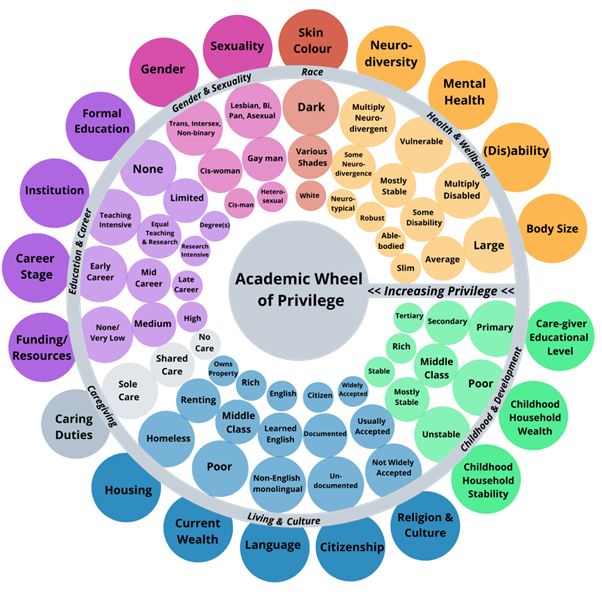
I have attached a link to the Wheel of Privilege, produced by the United Kingdom Research Integrity Office. Please view the image and follow the external link to their resource webpage to learn more.

Talking points:

1. Johnson discusses how most of the issue is a lack of conversation about privilege. A lot of teachers at my school are nervous that they will get in trouble for discussing race, gender, and societal issues. The district has a new cultural competency initiative. However, you see teachers getting accused of "radicalizing" their students in the media every day. How do I discuss these things without the fear of getting in trouble? Johnson includes some ideas, but I am curious to hear from my classmates. How have you seen this done well? How have your administrators supported you? 

2. "Ignoring privilege keeps us in a state of unreality, by promoting the illision that difference by itself is the problem. This quote from Johnson really resonates with me. "Keeping things the same as they have always been" shouldn't be the goal. Growing up I always heard "don't talk about politics". This can connect to any social issue. We should WANT to discuss privilege in order to grow. Johnson thinks it is crucial. I think the media can victimize the "difference" and not the issue itself.

3. The concept of being privileged without feeling privileged stands out to me. This is highlighted in the last few pages of the text. I have heard men deny the existence of male privilege. In my personal experience, they are thinking too individualistically. White Americans have been in a state of priviledge for so long it has become our normal. Personally, it wasn't brought up for most of my life. It seemed like a foreign concept introduced to me in the last few years. According to Johnson, privilege is aligned with social category, not indivdual experience. You can be a man and still have bad experiences, but how often are these bad experience caused by being male?

Argument Statement:

This author, Allan G. Johnson argues that privilege is not tied to an individual, but to society. 

First Post

I am a school nurse in a middle school. This is my second year after working inpatient for 13 years.

I cannot wait to spend my summer at the beach! This is such a nice bonus of working in a school. I am so lucky!
I love seeing shows on Broadway! My favorite is Jagged Little Pill. I've seen it many times. I could talk about it for ages!

 testing

Project Slides

Power Point Slides